
Peptide Coupling Reagents
In modern peptide synthesis, standard amide bond formation is predominantly achieved via carboxyl group activation methodologies. The earliest protocols utilized methods such as acyl chlorides, azides, symmetric anhydrides, and mixed anhydrides. However, due to harsh reaction conditions, susceptibility to amino acid racemization, explosive hazards, and cumbersome preparation processes, these classic methods have been progressively replaced by sophisticated, modern coupling reagents. Based on their core chemical structures, these modern reagents are primarily classified into two major categories: Carbodiimides and Onium Salts (including Phosphonium and Aminium/Uronium salts).
■ 1.2.1 Carbodiimide Reagents
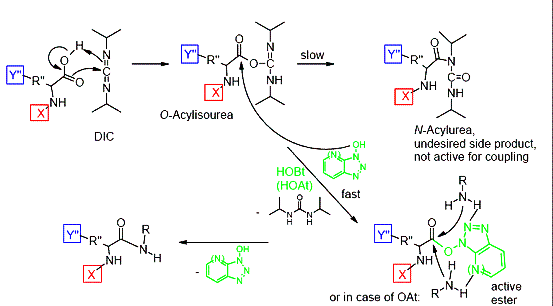
This class primarily includes DCC, DIC, and EDC·HCl, which react via the formation of active O-acylisourea intermediates. When employing DCC, the resulting byproduct, dicyclohexylurea (DCU), exhibits extremely low solubility in DMF, precipitating out as a white crystalline solid. Consequently, DCC is rarely utilized in solid-phase peptide synthesis (SPPS). However, owing to its exceptional cost-efficiency, it remains widely used in liquid-phase assembly where the DCU precipitate can be easily removed via filtration. EDC·HCl is heavily favored in bioconjugation and protein crosslinking due to its water-soluble characteristics and has achieved significant commercial success.
A major inherent drawback of carbodiimide reagents is the generation of significant side reactions when utilized in isolation. Nevertheless, extensive research demonstrates that introducing additive reagents such as HOBt or HOAt during the activation stage can suppress side reactions to an exceptionally minimal threshold. The detailed reaction mechanism is illustrated below:
■ 1.2.2 Onium Salt Reagents
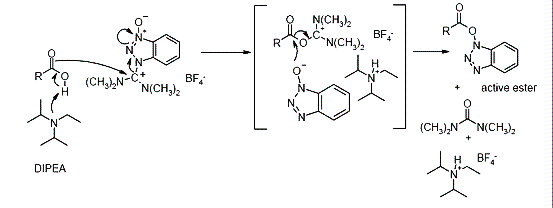
Onium salt coupling reagents feature superior activation efficiency and exceptionally fast reaction kinetics, making them widely adopted across the industry. Prominent examples include HBTU, TBTU, HATU, and PyBOP. These reagents strictly require the addition of an organic base—typically N,N-Diisopropylethylamine (DIPEA) or N-Methylmorpholine (NMM)—to deprotonate and activate the amino acid carboxylate before coupling can proceed. Their precise reaction mechanism is detailed below:
Common Resins Utilized in Solid-Phase Peptide Synthesis (SPPS)
Solid-phase peptide synthesis resins are predominantly composed of polystyrene-divinylbenzene (PS-DVB) matrices, with particle sizes typically ranging between 75–150 μm and a cross-linking degree calibrated at 1%–2% (with 1% being the industry standard). Because of this optimal cross-linking density, the resin beads exhibit superior swelling characteristics in organic solvents like DMF and DCM, creating a spatial 3D macromolecular network that allows reactant molecules to diffuse freely inside the resin core.
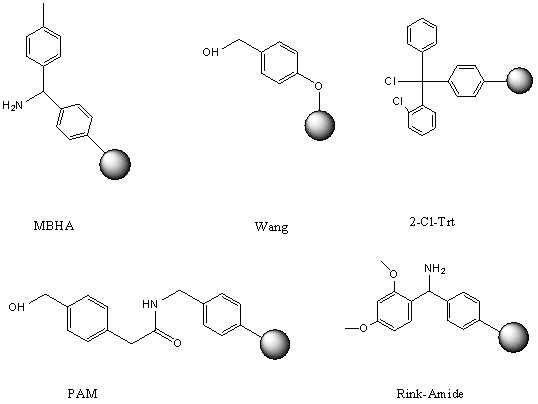
Structurally, the most critical element of an SPPS resin is its linker arm. One terminus of the linker is covalently anchored to the inert polymer matrix, while the opposing terminus serves as the functional reaction site for peptide chain anchoring. Resins widely utilized in modern laboratories include: PAM, MBHA, Wang, 2-Cl-Trt, and Rink-Amide-MBHA. Among these, PAM and MBHA resins are strictly tailored for Boc-chemistry strategies. Because their anchor linkers are exceptionally stable, harsh cleavage conditions involving liquid hydrofluoric acid (HF) or trifluoromethanesulfonic acid (TFMSA) are mandatory to cleave the final peptide from the resin matrix.
Cleavage Methodologies in Solid-Phase Peptide Synthesis
Upon successful completion of the solid-phase peptide chain assembly, a precise cleavage protocol must be executed to liberate the peptide from the resin matrix. The crude peptide is subsequently precipitated using ice-cold diethyl ether, isolated via centrifugation, purified to high homogeneity via preparative HPLC, and finally lyophilized to yield the final purified peptide product.
Because different resin linkers feature diverse chemical characteristics and amino acid sequences vary drastically, cleavage parameters must be precisely customized. Generally, parameters are selected to match the acid-lability profile required for cleavage. For PAM and MBHA resins, harsh HF cleavage protocols are mandatory. During this highly acidic process, scavengers such as p-cresol and dimethyl sulfide must be added to suppress carbocation side reactions. Conversely, for Wang, Rink-Amide, and Trt resins, standard TFA-mediated cleavage is employed. Scavengers commonly blended into the TFA cocktail include ethanedithiol (EDT), water, triisopropylsilane (TIS), and anisole.
The primary role of these nucleophilic scavengers is to capture carbocations generated during the global side-chain deprotection and cleavage steps. By trapping these highly reactive electrophilic species, scavengers efficiently prevent back-attack on electron-rich amino acid side chains (such as Trp and Tyr), minimizing the generation of alkylated peptide side-products. Amino acids highly susceptible to these side reactions include Trp and Tyr, necessitating an increased scavenger volume (typically 10–15 mL per gram of resin).
| Cleavage Strategy | Standard Reagent Ratios (v/v) | Reaction Parameters |
|---|---|---|
| Boc-Chemistry (HF) | HF / p-cresol / p-thiocresol (90 / 5 / 5) |
0°C, 1 – 1.5 hours |
| Fmoc-Chemistry (TFA) | TFA / TIS / EDT / H2O (94 / 1 / 2.5 / 2.5) |
Room Temperature, 2 – 4 hours |
Synthesis of Difficult and Sterically Hindered Peptide Sequences
During solid-phase peptide synthesis, operators frequently encounter total sequence failure or extremely degraded coupling efficiency. The fundamental root cause is typically driven by the inherent peptide sequence itself. Certain hydrophobic or highly repetitive domains tend to form stable intermolecular or intramolecular β-sheet secondary structures right on the solid matrix. This structural aggregation severely destroys the resin’s optimal swelling performance in organic solvents, effectively burying the active terminal amino reaction sites inside the collapsed resin core and blocking incoming reagents.
■ Primary Engineering Methodologies & Troubleshooting Protocols:
- ✔ Utilize specialized binary/ternary solvent matrices, such as DMSO/DMF or 6N Pyridine/DMF solutions.
- ✔ Elevate the coupling reaction temperature, or implement advanced Microwave-Assisted Peptide Synthesis protocols.
- ✔ Introduce inorganic chaotropic salt additives, including high-purity LiCl or NaClO4 solutions.
- ✔ Transition to next-generation, high-swelling PEG-grafted resins (e.g., NovaSyn TG, ChemMatrix), while simultaneously reducing the functional resin loading density to a low threshold (0.05–0.2 mmol/g).