
Mechanisms & Role of Disulfide Bonds in Peptide Architecture
Disulfide bonds serve as vital covalent configurations governing the secondary and tertiary structural stability of numerous peptides and functional proteins. These critical linkages are widely observed across almost all eukaryotic extracellular proteins, secretory peptides, and peptide toxins. Structurally, a disulfide bridge is formed via the selective oxidative coupling of two proximal Cysteine (Cys) sulfhydryl (-SH) side chains. The introduction of these covalent cross-links significantly restricts the conformational flexibility of the peptide backbone, driving enhanced binding affinity toward target receptors and providing robust metabolic protection against fast-acting proteolytic degradation within serum environments.
When a target sequence houses only a single pair of Cysteine residues, the cyclization cascade is highly straightforward. The linear peptide chain can be smoothly assembled via standard solid-phase or liquid-phase strategies and subsequently oxidized under mild alkaline liquid buffers (typically monitored within a precise pH 8.0 to 9.0 window) to yield the intended cyclic architecture. However, when complex multi-site configurations require the precise mapping of two, three, or more distinct disulfide pairs, spontaneous thermodynamic oxidation inevitably triggers chaotic mismatched cross-linking, producing biologically inactive structural isomers. To eliminate this issue, advanced orthogonal protection schemes must be deployed during chain elongation.
Advanced Orthogonal Regioselective Pairing Platforms
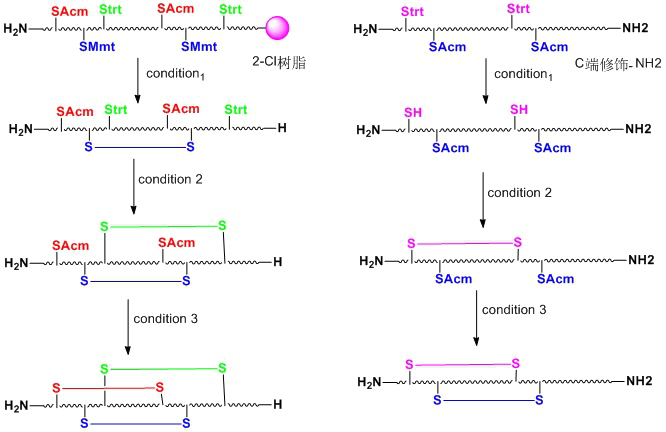
To achieve absolute structural accuracy in multi-disulfide systems, Genixpep applies a highly selective chemical deprotection strategy. By leveraging distinct side-chain protecting groups with orthogonal cleavage profiles, we direct the sequential unmasking and oxidation of specific sulfhydryl pairs on the resin or in solution.
Regioselective Oxidation on 2-Cl & Rink Amide Matrix
The diagram below demonstrates our optimized pathways using 2-Chlorotrityl Chloride Resin and Rink Amide Resin supports. By combining standard acid-labile groups (like Trt) with iodine-oxidizable tags (like Acm), the first disulfide bridge is formed under mild conditions while the remaining pairs stay completely protected. This sequence allows step-wise, controlled folding of highly intricate multi-cyclic peptide structures.
Pre-Formed Disulfide Dimer Engineering
While multi-pair cyclization is typically executed during the final post-assembly processing stages, certain complex architectures require the insertion of pre-formed disulfide building blocks. This approach allows the smooth incorporation of pre-oxidized cystine segments directly during active coupling cycles, which effectively prevents premature chain termination and scales up final target synthesis yields.
Genixpep Cyclization & Disulfide Customization Matrix
Leveraging our established liquid-phase and on-resin oxidative platforms, Genixpep delivers a comprehensive portfolio of structurally verified cyclic peptides configured to specific folding coordinates.
Single Disulfide Cyclization
- 1x Disulfide Pair (Intrachain Monocyclic)
- Head-to-Tail Intramolecular Amide Bridges
- Side-Chain-to-Tail Cyclic Constructs
- Mild Liquid Buffer Aerial Oxidation Control
Multiplexed Multi-Disulfide Folding
- Dual Disulfide Pairs (2x Bridges, Bicyclic)
- Triple Disulfide Pairs (3x Bridges, Tricyclic)
- Orthogonal Regioselective Trt/Acm Pairing
- Directed Isomeric Folding Layouts
Intermolecular & Custom Linking
- Symmetrical Intermolecular Disulfide Dimers
- Asymmetrical Intermolecular Disulfide Dimers
- Mpa (Beta-Mercatopropionic Acid) N-Terminal Cyclization
- Thioether / Stable Non-Reducible Isosteres